Propiedad CSS column-rule-style
La propiedad column-rule-style especifica el estilo de la regla entre columnas. Una column-rule es similar a un borde que puedes agregar para separar columnas adyacentes. También puede tener estilos como un borde.
Esta propiedad es una de las propiedades CSS3.
Para usar esta propiedad, primero debes definir las columnas utilizando las propiedades columns o column-count.
La propiedad column-rule-style tiene los siguientes valores:
- none
- hidden
- dotted
- dashed
- solid
- double
- groove
- ridge
- inset
- outset
| Valor inicial | none |
|---|---|
| Se aplica a | Elementos multicol. |
| Heredable | No. |
| Animable | No. |
| Versión | CSS3 |
| Sintaxis DOM | object.style.columnRuleStyle = "dashed" ; |
Sintaxis
Sintaxis de la propiedad CSS column-rule-style
column-rule-style: none | hidden | dotted | dashed | solid | double | groove | ridge | inset | outset | initial | inherit;Ejemplo de la propiedad column-rule-style:
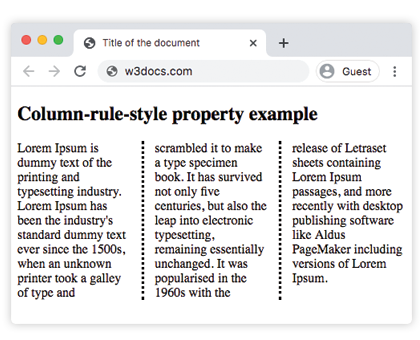
Ejemplo de la propiedad CSS column-rule-style con valor dotted
<!DOCTYPE html>
<html>
  <head>
    <title>Title of the document</title>
    <style>
      div {
        column-count: 3;
        column-gap: 30px;
        column-rule-style: dotted;
      }
    </style>
  </head>
  <body>
    <h2>Column-rule-style property example</h2>
    <div>
      Lorem Ipsum is dummy text of the printing and typesetting industry. Lorem Ipsum has been the industry's standard dummy text ever since the 1500s, when an unknown printer took a galley of type and scrambled it to make a type specimen book. It has survived not only five centuries, but also the leap into electronic typesetting, remaining essentially unchanged. It was popularised in the 1960s with the release of Letraset sheets containing Lorem Ipsum passages, and more recently with desktop publishing software like Aldus PageMaker including versions of Lorem Ipsum.
    </div>
  </body>
</html>Resultado
En el siguiente ejemplo, las reglas entre columnas son dobles. En este ejemplo, el color se especifica para la regla mediante la propiedad column-rule-color.
Ejemplo de la propiedad column-rule-style con el valor "double":
Ejemplo de la propiedad CSS column-rule-style con valor double
<!DOCTYPE html>
<html>
  <head>
    <title>Title of the document</title>
    <style>
      div {
        column-count: 3;
        column-gap: 30px;
        column-rule-style: double;
        column-rule-color: #1c87c9;
        column-rule-width: 5px;
        text-align: justify;
      }
    </style>
  </head>
  <body>
    <h1>Column-rule-style property example</h1>
    <div>
      Lorem Ipsum is dummy text of the printing and typesetting industry. Lorem Ipsum has been the industry's standard dummy text ever since the 1500s, when an unknown printer took a galley of type and scrambled it to make a type specimen book. It has survived not only five centuries, but also the leap into electronic typesetting, remaining essentially unchanged. It was popularised in the 1960s with the release of Letraset sheets containing Lorem Ipsum passages, and more recently with desktop publishing software like Aldus PageMaker including versions of Lorem Ipsum.
    </div>
  </body>
</html>Valores
| Valor | Descripción |
|---|---|
| none | No se define ninguna regla. Este es el valor predeterminado. |
| hidden | La regla está oculta. |
| dotted | La regla es de puntos. |
| dashed | La regla es discontinua. |
| solid | La regla es sólida. |
| double | La regla es doble. |
| groove | La regla es un surco 3D. Los valores de ancho y color definen el efecto. |
| ridge | La regla es un relieve 3D. Los valores de ancho y color definen el efecto. |
| inset | La regla es un hundimiento 3D. Los valores de ancho y color definen el efecto. |
| outset | La regla es un resalte 3D. Los valores de ancho y color definen el efecto. |
| initial | Establece la propiedad en su valor predeterminado. |
| inherit | Hereda la propiedad de su elemento padre. |
Práctica
¿Cuáles de las siguientes afirmaciones son verdaderas sobre la propiedad CSS column-rule-style?