Propiedad CSS isolation
La propiedad isolation te permite crear un nuevo contexto de apilamiento. Comúnmente se usa junto con la propiedad mix-blend-mode.
Al usar background-blend-mode, no se necesita la propiedad isolation porque las capas de fondo solo se mezclan entre sí, no con el contenido de la página detrás de ellas.
INFO
En CSS, la propiedad isolation se utiliza principalmente para aislar los efectos de mix-blend-mode o filter, evitando que afecten a los contextos de apilamiento padre o hijo.
| Valor inicial | auto |
|---|---|
| Se aplica a | Todos los elementos. |
| Heredable | No. |
| Animable | No. |
| Versión | CSS3 |
| Sintaxis DOM | Object.style.isolation = "isolate"; |
Sintaxis
Sintaxis de CSS isolation
css
isolation: auto | isolate | initial | inherit;Ejemplo de la propiedad isolation:
Ejemplo de código de CSS isolation
html
<!DOCTYPE html>
<html>
  <head>
    <title>Title of the document</title>
    <style>
      .a {
        background-color: #ccc;
      }
      #isolation-example {
        width: 300px;
        height: 300px;
      }
      .c {
        width: 100px;
        height: 100px;
        border: 1px solid #000;
        padding: 10px;
        mix-blend-mode: difference;
      }
      #isolation-example1 {
        isolation: auto;
      }
      #isolation-example2 {
        isolation: isolate;
      }
    </style>
  </head>
  <body>
    <h2>Isolation property example</h2>
    <div id="isolation-example" class="a">
      <div id="isolation-example1">
        <div class="a c">isolation: auto;</div>
      </div>
      <div id="isolation-example2">
        <div class="a c">isolation: isolate;</div>
      </div>
    </div>
  </body>
</html>Resultado
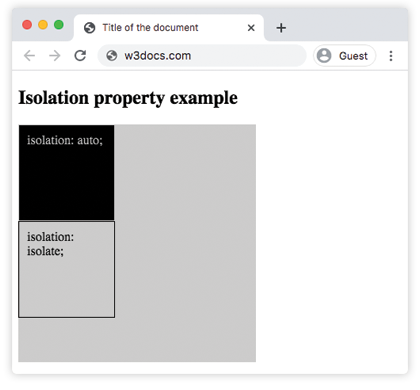
Ejemplo de la propiedad isolation con la propiedad mix-blend-mode:
Otro ejemplo de código de CSS isolation
html
<!DOCTYPE html>
<html>
  <head>
    <title>Title of the document</title>
    <style>
      * {
        box-sizing: border-box;
      }
      body {
        background-color: #eee;
        color: #555;
        font-size: 1.1em;
        font-family: Roboto, Helvetica, Arial, sans-serif;
      }
      .isolation-example {
        margin: 1em auto;
        width: 100%;
        max-width: 814px;
        position: relative;
      }
      img {
        width: 100%;
      }
      .isolation-example h1 {
        position: absolute;
        top: 5em;
        color: white;
        text-align: center;
        font-size: 40px;
        width: 100%;
        text-transform: uppercase;
        background-color: #000;
        padding: .5em .25em;
        mix-blend-mode: overlay;
        isolation: isolate;
      }
    </style>
  </head>
  <body>
    <h2>Isolation property example</h2>
    <div class="isolation-example">
      <img src="https://es.w3docs.com/uploads/media/default/0001/01/4982c4f43023330a662b9baed5a407e391ae6161.jpeg" alt="Yellow tree." />
      <div class="element">
        <h1>House</h1>
      </div>
    </div>
  </body>
</html>Valores
| Valor | Descripción |
|---|---|
| auto | No se crea un nuevo contexto de apilamiento a menos que otras propiedades (como mix-blend-mode o filter) lo requieran. Este es el valor predeterminado. |
| isolate | Crea un contexto de apilamiento en un elemento y aísla el grupo. |
| initial | Hace que la propiedad use su valor predeterminado. |
| inherit | Hereda la propiedad de su elemento padre. |
Práctica
¿Qué hace la propiedad 'isolation' en CSS?