Clase pseudo :first-child de CSS
La clase pseudo :first-child de CSS selecciona el elemento si es el primer hijo entre otros elementos.
El selector :first-of-type se puede utilizar si el usuario desea seleccionar y aplicar el estilo al primer párrafo. El selector :first-child es en realidad similar a :first-of-type, pero existe una diferencia: coinciden con condiciones diferentes. :first-child coincide con un elemento solo si es el primer hijo de su padre, mientras que :first-of-type coincide con el primer elemento de su tipo específico entre sus hermanos.
Versión
Sintaxis
Ejemplo de sintaxis de CSS :first-child
:first-child {
  css declarations;
}
Ejemplo de la clase pseudo :first-child con la etiqueta <p>:
Ejemplo de código CSS :first-child
<!DOCTYPE html>
<html>
  <head>
    <title>Title of the document</title>
    <style>
      p:first-child {
        background-color: #1c87c9;
        color: #fff;
      }
    </style>
  </head>
  <body>
    <p>Lorem ipsum is simply dummy text...</p>
    <h2>First-child selector example</h2>
    <p>Lorem Ipsum is simply dummy text...</p>
  </body>
</html>Ejemplo de la clase pseudo :first-child con la etiqueta <li>:
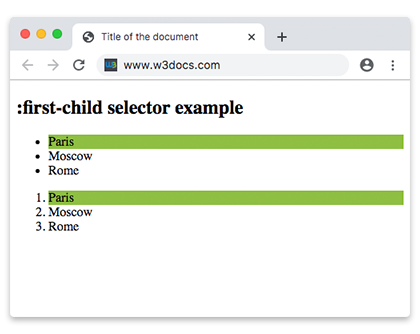
Otro ejemplo de código CSS :first-child
<!DOCTYPE html>
<html>
  <head>
    <title>Title of the document</title>
    <style>
      li:first-child {
        background: #8ebf42;
      }
    </style>
  </head>
  <body>
    <h2>:first-child selector example</h2>
    <ul>
      <li>Paris</li>
      <li>Moscow</li>
      <li>Rome</li>
    </ul>
    <ol>
      <li>Paris</li>
      <li>Moscow</li>
      <li>Rome</li>
    </ol>
  </body>
</html>Ejemplo de la clase pseudo :first-child con la etiqueta <ol>:
Ejemplo del selector :first-child con la etiqueta HTML ol
<!DOCTYPE html>
<html>
  <head>
    <title>Title of the document</title>
    <style>
      ol:first-child {
        background: #8ebf42;
      }
    </style>
  </head>
  <body>
    <ol>
      <li>London</li>
      <li>Paris</li>
      <li>Rome</li>
    </ol>
    <ol>
      <li>London</li>
      <li>Paris</li>
      <li>Rome</li>
    </ol>
  </body>
</html>Ejemplo de la clase pseudo :first-child con la etiqueta <em>:
Ejemplo del selector :first-child con la etiqueta HTML em
<!DOCTYPE html>
<html>
  <head>
    <title>Title of the document</title>
    <style>
      p em:first-child {
        background: #82b534;
      }
    </style>
  </head>
  <body>
    <h2>:first-child selector example</h2>
    <article>
      <p>Here is a <em>some</em> text. This is a <em>example</em>.</p>
      <p>Here is a <em>some</em> text. This is a <em>example</em>.</p>
      <p>Here is a <em>some</em> text. This is a <em>example</em>.</p>
    </article>
  </body>
</html>Ejemplo de la clase pseudo :first-child con la etiqueta <ul>:
Ejemplo del selector :first-child con la etiqueta HTML ul
<!DOCTYPE html>
<html>
  <head>
    <title>Title of the document</title>
    <style>
      ul li {
        color: blue;
      }
      ul li:first-child {
        color: #8ebf42;
        font-weight: bold;
      }
    </style>
  </head>
  <body>
    <h2>:first-child selector example</h2>
    <ul>
      <li>List Item 1</li>
      <li>List Item 2</li>
      <li>
        List Item 3
        <ul>
          <li>List Item 3.1</li>
          <li>List Item 3.2</li>
          <li>List Item 3.3</li>
        </ul>
      </li>
    </ul>
  </body>
</html>Práctica
¿Qué representa la clase pseudo :first-child en CSS?